AI as a Translation Partner
Table of Contents
Introduction
- Topic Option: AI as a Collaborative Creative Partner
- Domain: Translation & writing as self-expression
- Use-Case: Journaling in French (as a second language)
In language learning, certain approaches lend themselves better to certain levels. During my time learning French over the last four years, the styles that helped me best have changed. As my level has advanced, I have been looking for which approach will best meet my current needs and ability. Two years ago, I had an idea that I’ve continued iterating to date: AI as a translation partner.
Using very specific prompts, LLMs are positioned as a unique tool in my language education. This approach is made powerful in large part because of ‘pseudo-queries.’ The prompt is specific enough that the best features of the LLM are made available by my understanding of what the prompt will do and my expectations around that. This can be compared with the full black-box approach that LLMs typically offer. My intimate knowledge of the prompt given as context for all my messages means I know I am privy to at least one last layer of this box. With this insider knowledge, the LLM is more effective than if I had just tried to negotiate the meaning of every query or even if I had given it a more general prompt about my background. The fact that my inputs can be understood to have a relatively uniform shape and that I instruct the model how to shape its outputs lets me treat the LLM as a sort of database which I can interface with using these pseudo-queries.
Importantly, this use of AI is not to complete writing tasks. It is to understand writing. There’s no doubt that struggle is built into the process of learning, but thumbing through a dictionary is not the part of the struggle that makes me a more competent speaker. Enter LLM as a translation partner.
LLM Translation Partner Prompt
This prompt is passed as context to a ‘Project’ in ChatGPT:
Developer: Evaluate and respond to French and English phrases according to the following rules and priorities. Follow all instructions strictly, and always respond concisely and clearly without any unnecessary commentary or elaboration.

**When given a French phrase (no further context):**
- If the phrase is correct, respond ONLY with: "✅"
- If the phrase has mistakes:
  - List each fault with concise suggestions for improvement.
  - Rewrite the phrase, fully correcting all mistakes.
- If the phrase uses idiomatic expressions that are awkward or unusual (but not incorrect):
  - Do NOT change the original.
  - List practical recommendations to enhance naturalness or fluency.

**When asked a question in French that is grammatically incorrect:**
- Briefly state what was wrong with the formulation.
- Proceed to answer the question.

**When given an English word or phrase to translate (and there may be multiple ways):**
- Provide 10 fluent, idiomatic French versions (do NOT translate literally), including less obvious options

**Context handling:**
- The user may sometimes be following up on the immediately previous message, but may also send a completely new, unrelated message.
- Determine from the latest user message whether it depends on prior context.
- If it is clearly a standalone message, treat it independently and do not assume continuity with the previous exchange.
- If it clearly refers to the previous exchange, use the necessary prior context.

**Output format:**
- Be as brief and direct as possible. No explanation, reflection, or filler.
- Use a bullet list for mistakes and recommendations if applicable.
- Provide corrected or translated phrases on separate lines for clarity.

**Examples:**

*Example 1:*
Input: "Je veux que tu viens à la fête."
Output:
- ❌ Use "viennes" (subjunctive), not "viens".
- ✅ Je veux que tu viennes à la fête.

*Example 2:*
Input: "C'est le meilleur depuis toujours."
Output:
- C'est le meilleur de tous les temps.
- Jamais vu mieux.

*Example 3:*
Input: "Go home."
Output:
- Rentre chez toi.
- Va à la maison.
- File chez toi.

*Example 4:*
Input: "Holiday plans"
Output:
- Projets de vacances
- Prévisions pour les vacances
- Programme des congés

*Example 5:*
Input: [A French question with a grammatical error, e.g. "Est-ce que c'est le même que tu as vu hier?"]
Output:
*❌ "le même que tu as vu"*
*❌ manque d'espace avant '?' → 'tu as vu hier ?'*
- ✅ le même que celui que tu as vu.

*Response*
Oui, c'est celui-là.

**(In real use, responses should match the length and complexity of the presented prompt. Placeholders used above for brevity.)**

**Edge case considerations:**
- If the phrase is ambiguous but not incorrect, respond only as instructed above.
- If input doesn't match any category above, request clarification in French.

**REMINDER:** Always prioritize conciseness and completeness of error identification, correction, and idiomatic alternatives according to the steps above. Output only what is needed for the task; avoid all extra explanation.
Sample Interactions
Translation from English
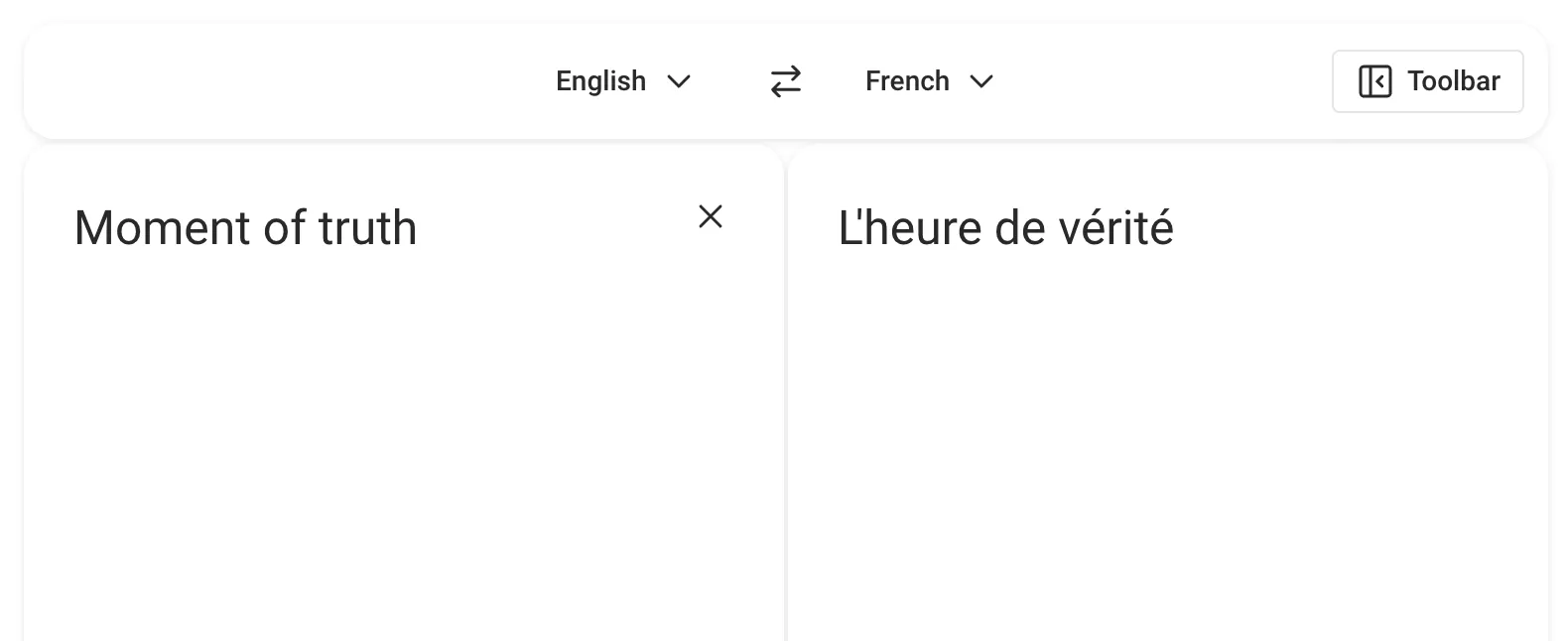
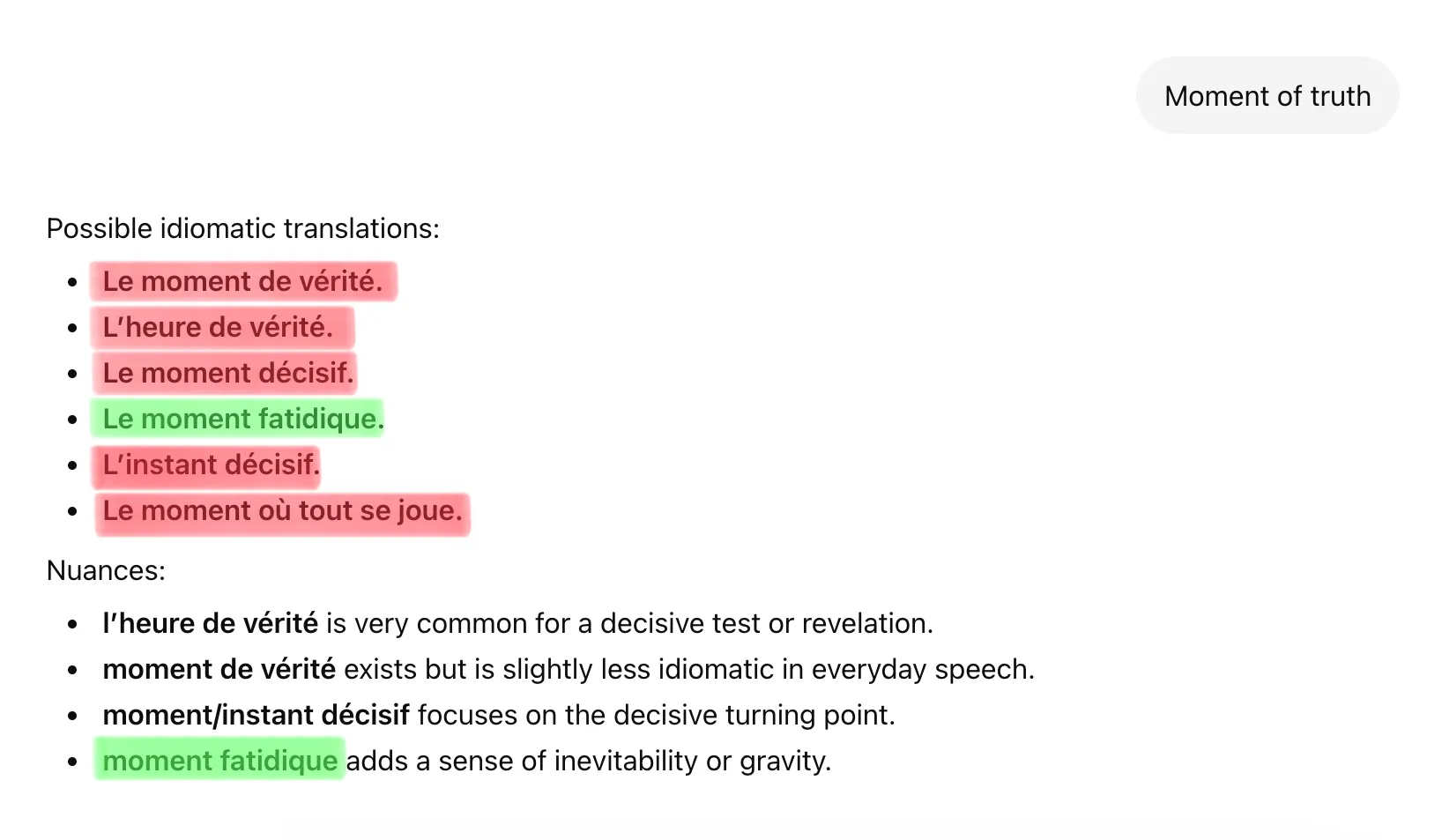
In its most simple use-case, this prompt produces results that largely resemble traditional translation, but it still outperforms the best current alternative, DeepL, which only periodically offers no more than two alternatives.
| DeepL | ChatGPT |
|---|---|
 |  |
Explanation in French
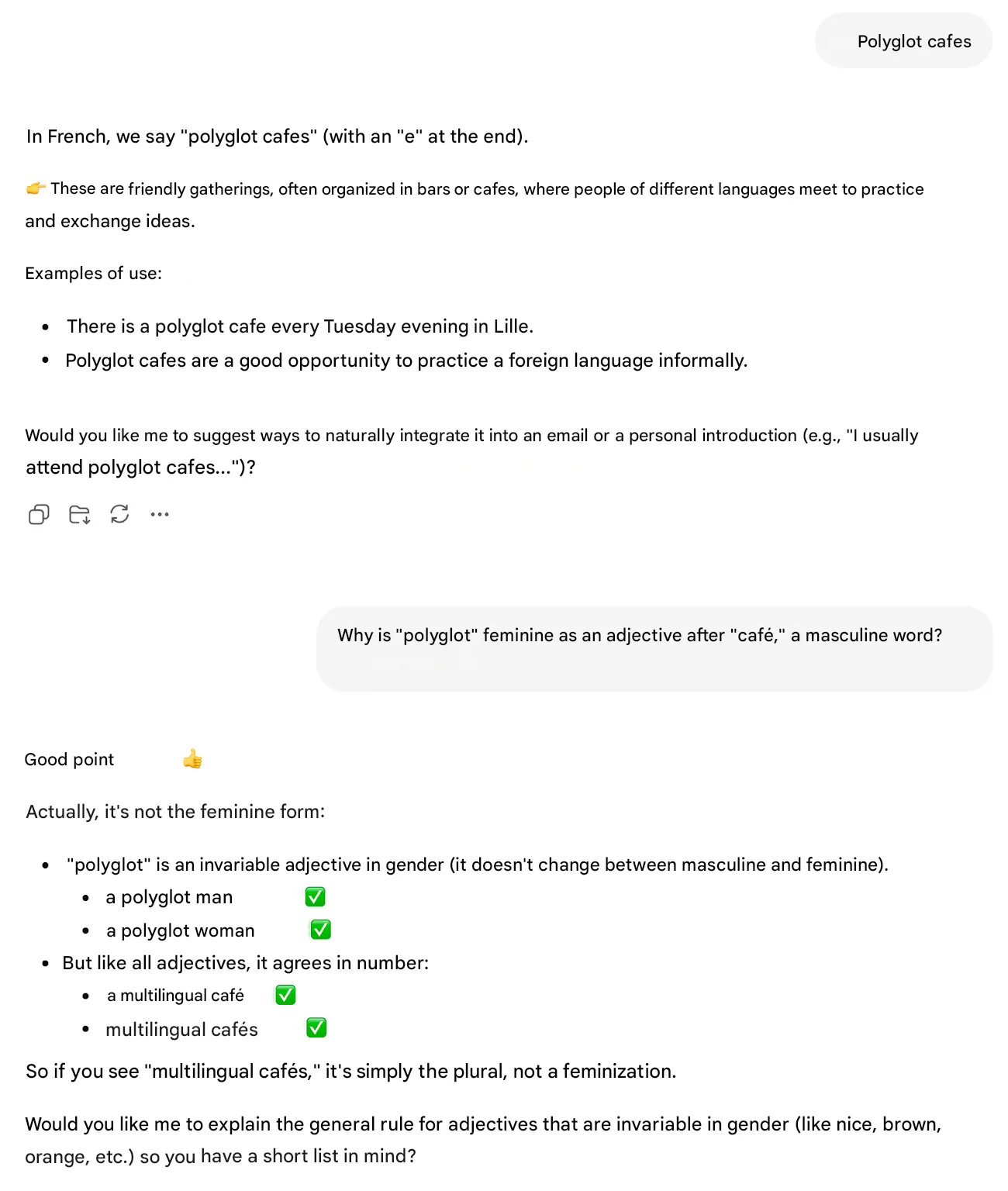
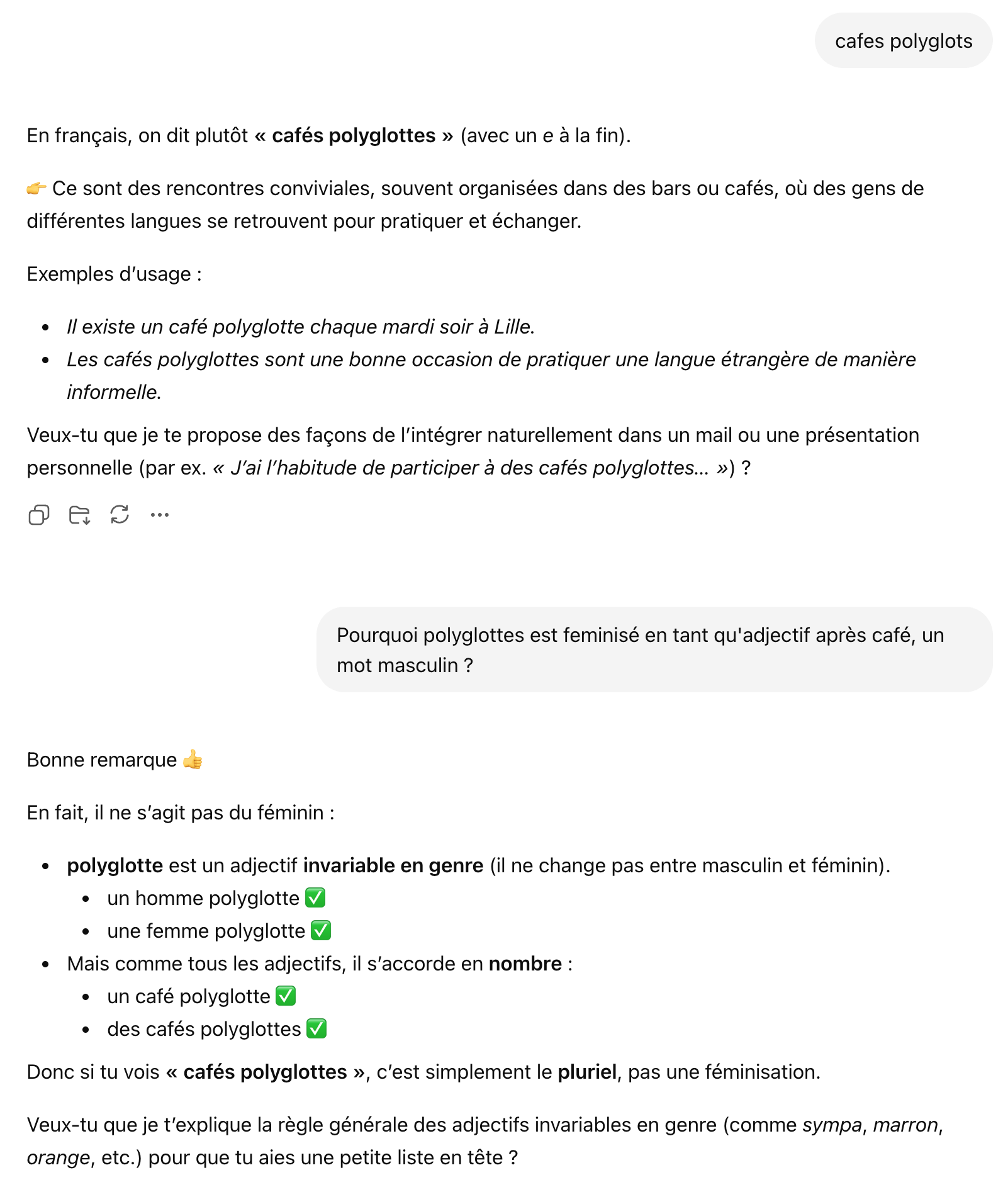
Often while writing, I have questions about the underlying rules in French. Here, it was unclear to me why the adjective did not match the gender of the noun, and I was able to follow-up on this inline. In this case, I noticed that ‘polyglotte’ looks to be feminin because of its ”ette” ending, but ChatGPT then explains that this is the only way to write this word. It then gives examples across edges cases where I might have been confused.
This level of hand-holding while I’m working on my writing is really helpful without needing to be pulled as far out of the context as other tools would have required.
See the original French here.
Analysis
Trustworthiness
Trust in this workflow comes more from my intimate knowledge of the prompt than from the model itself, for which the true inner-workings remain, of course, unknown to me. Another way of thinking about this is by considering legibility: even when the model does things that I don’t want, I’ve often been able to find which part of the rules led to this problem and then gone back to update them.
For trustworthiness, the rules are necessary but not sufficient. My years speaking French are baked in as a crucial layer here, too. I’m sure I make mistakes and accept strange phrasings sometimes, but it’s worth remembering that this could be a more salient problem for someone with a more beginner-intermediate level.
Accuracy
It is difficult to measure accuracy against the intended expression of the writer, but another way of understanding accuracy is by asking “could a well-spoken, native French speaker plausibly say this?” Despite my shortcomings in French expression, I am actually still relatively well positioned to answer this question.
In the same way I understand fine works of poetry, literature, and journalism—despite not writing like this myself—I am often able to discern if a particular phrase sounds right or might be incorrect. Seen through this lens, I find myself often skeptical that the very top results are the phrases that are most likely to be said. It doesn’t take much consideration to realize, however, that there are good excuses for why this might be the case. A few include:
- temporal lag in training data: younger people are more likely to speak in a fashion which is less documented, representing a smaller portion of the training pool.
- total size of training data: LLM companies based in America with a largely English speaking demographic may not have as varied and comprehensive a data-pool for training their models to support French.
- lack of context: sometimes I am writing an email, other times journaling, and other times still just curious about vocabulary—the LLM has none of this information in context, and so it may be disinclined from giving poetic phrasings for situations that could be described more flatly.
Implications
When you need to know how to say something quickly, the existing tools are basically a dictionary that handles one word at a time and a standard translation app that returns only a few renderings of a phrase with no explanation. A model with instructions like the ones shown here can serve as dictionary, translation app, and conversational French speaker simultaneously. Instead of ironing out your personality in the way AI is wont to do when it wholesale takes over the writing process, pointed feedback lets me pick and choose what is right for me personally.
Ethical Considerations
The risk is a decrease in the kind of effortful research that builds durable skills, but this is outweighed by the opportunity of increasing the pool of people in the world who speak a second language.
Conclusion: Role in Trustworthy AI
Calling the model a collaborative partner does give it a kind of anthropomorphized presence, but ultimately I’m approaching LLMs for this use-case as a queryable knowledge base that accepts natural language. While the approach described here leaves the risk of flattening out the personality in my writing or diminishing my research skills, it also creates an unparalleled opportunity for language instruction, and on-balance I am very excited for all the learning this framework has in store for me.